
Why Wu Tax Plan Misses the Mark: Spending Discipline Is the Clear Way To Affordability
by Amir Shahsavari
As small property owners, we know that when you ignore the real source of a leak, you get mold, rot, and a bigger bill later. Boston’s tax shift proposal takes the same short-sighted approach, catching the drips of a broken fiscal system while leaving the real structural issues untouched. Instead of repairing the underlying problems of overspending, vacancies, and inefficiencies, the City is asking commercial property owners to absorb the runoff. In today’s fragile market, that approach will only make the damage worse.
Boston is facing a genuine affordability challenge, and homeowners across the city are feeling the pressure of rising property taxes. SPOA supports meaningful relief for these residents. But Mayor Michelle Wu’s proposed tax-shift plan, which transfers a large share of the tax burden onto commercial properties, is not a real solution. The core drivers of Boston’s fiscal instability are clear: unchecked municipal spending growth, long-term office vacancies from the pandemic, chronic cost overruns on city projects, and regulatory bottlenecks that slow new development. Taxing struggling commercial properties in the weakest market in decades will only lead to property devaluation, rising loan defaults, and further erosion of the city’s tax base.
Small and mid-sized commercial property owners, many of them first generation and family-run businesses, are already operating at the edge. Long-term vacancies, insurance premiums up more than 40%, steep increases in utilities, rising labor and compliance costs: these are not temporary inconveniences. They are structural pressures that threaten the sustainability of many properties. A tax shift that ignores these realities will accelerate vacancies, discourage investment, and ultimately raise costs for workers, residents, and small business tenants. Shifting pain from one taxpayer group to another is not a strategy; it is a warning sign of deeper problems.
That is why the narrative must move away from “commercial vs. residential” or “landlord vs. tenant.” Boston’s real challenge is a fiscal system that costs too much and produces too little. The conversation should focus on systemic cost control, targeted relief, and economic growth, not redistribution.
Before the City considers shifting taxes onto already-struggling owners, it must demonstrate fiscal discipline. Concrete steps include:
1. Slowing City Payroll Growth
Payroll has grown faster than inflation for years
Overtime and pension liabilities continue to accelerate
Reforms should include hiring freezes outside public safety, reasonable overtime caps, and pension renegotiations
2. Cutting Reliance on Outside Consultants
Boston spends millions annually on:
IT consulting
Transportation planning
Legal and development advisory
The City should conduct contract audits, competitively rebid major contracts, and build more in-house capacity.
3. Eliminating Underperforming Programs
Boston continues to fund redundant, duplicative, or low-impact initiatives. These programs should be reviewed and, where necessary, retired.
Economic Growth, Not Tax Redistribution, is the Sustainable Solution
Boston cannot tax its way out of a vacancy crisis.The only sustainable solution is expanding the tax base through economic growth and redevelopment by creating new taxpayers, not squeezing existing ones.
Key strategies include:
Removing zoning barriers for adaptive reuse and historic rehabilitation
Speeding up permitting, inspections, and change of use approvals
Incentivizing small business tenancy and ground-floor activation
Supporting upper floor modernization and reinvestment
These actions stabilize neighborhoods, create jobs, attract investment, and generate new revenue without raising tax rates.
State-Level Relief Without Harmful Local Redistribution
Instead of shifting taxes locally, Massachusetts should expand statewide homeowner relief programs, including:
Increased circuit breaker credits
Energy cost offset programs
Incentives for landlords providing rents at or below market
Housing stabilization funds supported through state surpluses
These options relieve pressure without destabilizing Boston’s struggling commercial sector. Boston deserves thoughtful, long-term solutions, not short-term patch jobs. Let’s fix the roof, not place more buckets under the leaks.
by Amir Shahsavari
SPOA Makes the Case Against Rent Control at the State House and in the Media
by Tony Lopes and Amir Shahsavari
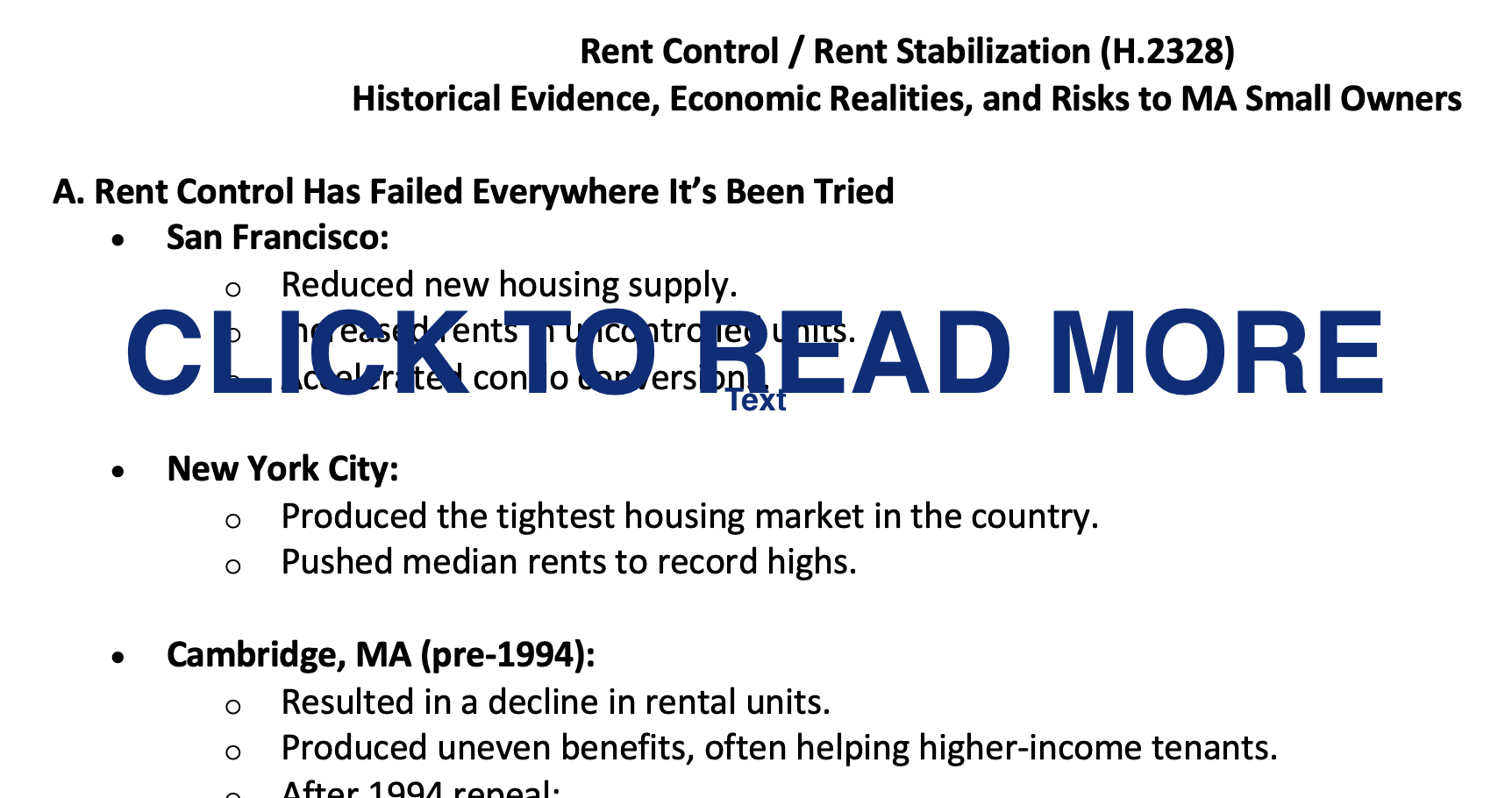
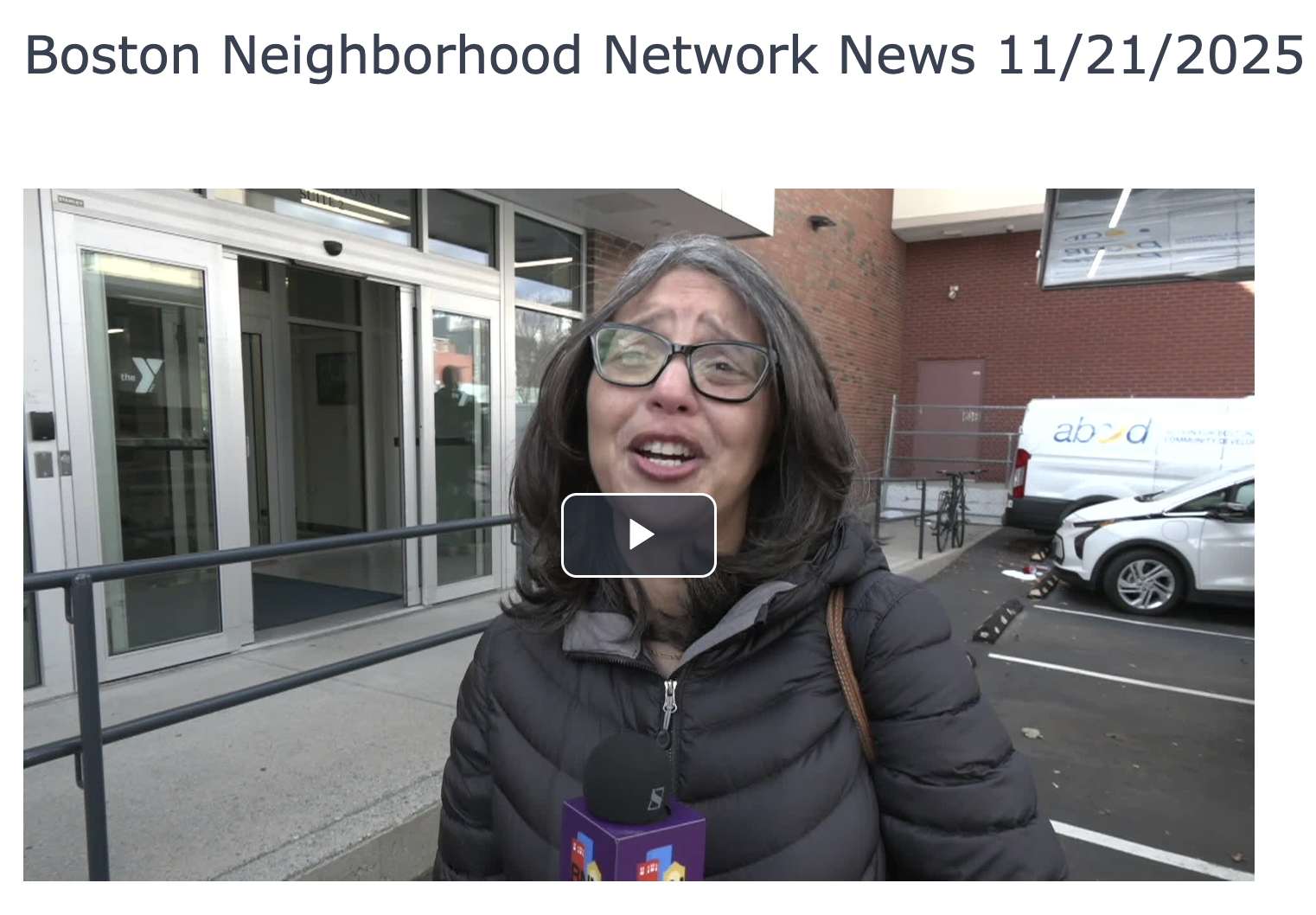
On Tuesday, November 19, 2025, SPOA members turned out to voice opposition to rent control and TOPA (Tenant Opportunity to Purchase Act, also known as tenant right of first refusal) at the Massachusetts State House and in the media. Tony Lopes and Shlomo Pinkas provided verbal and written testimony before the legislature about rent control and TOPA, while Chris Lehman addressed the rent control ballot measure exclusively with the televised news.
Below you will find a written transcript of SPOA's testimony before the Massachusetts legislature, as well as televised news coverage of the event. You will also find links to SPOA's separate interviews with CBS News and Boston 25 News.
by Tony Lopes and Amir Shahsavari
SPOA Releases Episode 21 of Housing Policy Series with "Mike Kennealy Gubernatorial Forum"
by Amir Shahsavari
The Small Property Owners Association (SPOA) is pleased to release Episode 21 of SPOA Housing Policy Series, which is called "Mike Kennealy Gubernatorial Forum."
We speak with Mike Kennealy, who is running for Governor of Massachusetts. Mr. Kennealy served as the Secretary of Housing and Economic Development under former Governor Charlie Baker. Prior to that, he served as Special Advisor in reforming the Lawrence Public Schools, following a career as a business leader in the private sector.
The conversation centers on Mr. Kennealy's housing positions, including his views about rent control, tenant right of first refusal (also known as the Tenant Opportunity to Purchase Act, or TOPA), eviction sealing, tenant credit check restrictions, and transparency in government. We discuss the state's funding of an extremist group that directed hate speech against property owners and others using taxpayer money. We address the need for more housing supply, as well as increased competition, to reduce prices and alleviate a struggling economic environment. We further address the high cost of energy, high taxes on the struggling business sector, the potential overturn of Proposition 2½, and SPOA's plan to help tenants achieve homeownership, while rewarding rental property owners for their contributions within a private-public partnership. In addition, what is Mr. Kennealy's message to small property owners struggling in Massachusetts?
Mr. Kennealy answers questions from SPOA members and our panel, which includes news reporter Scott Van Voorhis, who edits the independent newspaper Contrarian Boston, and Tony Lopes, the principal of M7 Real Estate Group.
SPOA Vice President, Amir Shahsavari, moderates the discussion.
As an organization, the Small Property Owners Association (SPOA) does not endorse political candidates. Therefore, this conversation is not an endorsement of Mr. Kennealy's candidacy by SPOA. However, SPOA extends an open invitation to all candidates to share their views about housing with us, whether they are running for governor or another office. We bring this information to you for educational purposes, but it is up to you, the voters, to decide the merits of the candidates' positions.
You can see the video in the link below.
by Amir Shahsavari
As Temperatures Drop Outside, Don't Let Your Property's Value Drop Too
by Demetrios Salpoglou
For owners to keep their well-maintained properties functional and holding their value, while attracting reliable tenants, it's not too late to take steps to make sure your properties don't decline, even amid dropping temperatures ahead of winter. These steps are covered in my article below from November.
The Leaves Are Falling—Don’t Let Your Boston Property Value Drop Too

by Demetrios Salpoglou