Massachusetts' Rent Control Ballot Question — And Why It's a Bad Idea
Massachusetts will be voting on a rent control ballot question this November. A supermajority of economists (95%!) and basically everyone who knows the business of real estate well understand that rent control is a counterproductive policy that achieves little benefit and comes with tremendous costs. But because it sounds nice at first glance, and most people haven’t really taken the time to fully understand what it entails, it’s constantly brought forward as a policy proposal to “fix” the rental housing system. Today, I’ll talk about the specific proposal that will be on the ballot this year, the general argument against rent control, and the specific findings of a study that just came out about the current proposal.
This year’s rent control proposal would limit annual rent increases in most rental units to the lower of 5% or the annual CPI increase, i.e. inflation. There are a few carve-outs, e.g. for newly constructed properties, small owner-occupied properties, and subsidized/below-market units, but it would still cover roughly 70% of rental units in the state. Notably, and unlike other recent rent control proposals that were structured as home rule petitions or “local option” measures, it would be applied to every city and town in the state, regardless of whether those municipalities want it. It’s a pretty extreme policy relative to those that are in effect in other parts of the US, both in terms of the strictness of its rent cap and the lack of choice that it gives to local governments.
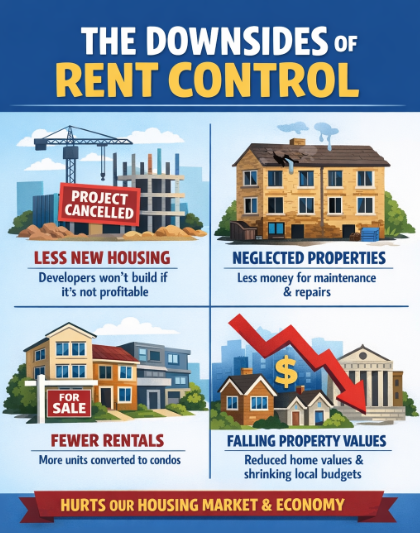
Rent control is broadly understood to have a wide variety of negative effects. Arguably the most important is its deterrence of new housing construction. Developers are much less likely to build new housing if it’s unlikely to be profitable, and the new construction exemption doesn’t help much with this–even if the developer isn’t planning on holding them past the 10yr expiration, someone will, and the price that someone will pay reflects the eventual application of rent control. This impact is especially important given that Massachusetts has a goal of adding 222,000 new housing units over the next decade. Governor Healey has noted that funding for several developers has already pulled out as a result of the ballot question. There’s no way this will happen under rent control, meaning that our housing shortage would end up being much more severe than it would otherwise.
Rent control also reduces spending on maintaining/upgrading existing rental housing: If landlords can’t charge enough to cover these costs, they often just won’t happen. This results in lower renter quality of life and also makes it harder to improve energy efficiency, especially in older buildings. Additionally, rent control incentivizes owners of existing rental units to convert them to condos, or in some cases to take them off the market altogether–see NYC’s 50,000 vacant units. This means that fewer units are left over for renters, increasing prices in the remaining market-rate rental units.
And, perhaps most importantly for the majority of MA voters who are homeowners as opposed to renters or landlords: rent control reduces property values. When rental properties earn less, they are worth less. This is basic math. But this impact isn’t limited to rental properties; it spills over to owner-occupied homes. The Tufts Center for State Policy Analysis estimates that this proposal would lower statewide property values by 14% over the next decade. This is bad for homeowner’s personal finances, of course, but it would also be disastrous for local government budgets, which are heavily dependent on property taxes. Cities and towns would then have to choose between deep budget cuts to critical service–education, transportation, police and fire departments–or big tax hikes, and at a time when many budgets, especially Boston’s, are already under significant stress.
As I’ve said before, the only way to sustainably make housing more affordable is to add more supply. Rent control runs counter to this goal and causes numerous other harms in the process. Groma has worked hard to build an operational stack that enables us to operate cost-effectively in a revenue-capped environment, so we’ll be okay in either case, but most developers, owners, and operators don’t have this advantage. It’s therefore critical for the state that we focus on more productive policy solutions to the housing crisis.
by Chris Lehman and Seth Priebatsch